Scan, price and list Riftbound cards in one workflow
Photograph or scan your Riftbound cards. NeoSatoshi reads the name, the set code and the printed number, keeps alternate art, overnumbered, signed and promo prints apart with their own prices, and turns the batch into eBay, Shopify or Cardmarket listings.
Built for the way Riftbound cards are sold
Card detection from photos and scans
Upload photos or scans of your Riftbound cards. NeoSatoshi reads the name and the collector line at the bottom left (for example OGN 066/298, 066a for an alternate art or 299* for a signed print) and adds the set, rarity, finish, a confidence value, alternative matches and current market prices. A wrong match is fixed with the manual search by name or number.
English cards, listed in English
English Riftbound cards are recognised, priced and listed. French and Chinese prints are recognised by their printing too, but they cannot be listed yet: NeoSatoshi names those rows instead of listing them under the wrong language.
Prices per printing and finish
Cardmarket prices in EUR, or in CHF or USD at the daily exchange rate, plus TCGplayer prices, always for exactly that printing and finish: a foil Common has its own price, and so do an alternate art and a signed print.
eBay Direct Listing and CSV
Publish straight to your eBay account or download the eBay CSV. The title reads like "Riftbound Kai'Sa, Daughter of the Void OGN 299* Signature Showcase", and game, manufacturer, set, card number, rarity and finish are filled in as item specifics.
Shopify products
Create products directly in your Shopify store, with a dry-run preview first, or export a Shopify CSV. The set code and the printed number go into the title, and a foil copy gets its own SKU, so a foil and a normal copy never share stock. NeoSatoshi is also available as an app in the Shopify App Store.
Cardmarket, custom exports and API
Download the TCGPowerTools import file for Cardmarket, with foil copies marked as foil, or a custom CSV or JSON export for other tools. Developers can send Riftbound cards to the Detection API with "tcg": "riftbound".
Daily price sync that never guesses
On the Business plan or higher, the daily price sync keeps your eBay and Shopify prices current, each printing and finish from its own price, and the stock sync keeps Shopify and eBay quantities in step. A printing the price sync cannot pin down is skipped, and a price you typed by hand is left alone.
Watched scan folder for document scanners
In desktop Chrome, Edge, Brave or Opera, NeoSatoshi watches the folder your scanner saves to, adds new JPEG or PNG scans automatically and pairs fronts and backs. Any document scanner that saves images into a folder works, with one card per scan.
Alternate art, overnumbered, signed: the printing decides the price
The set code and the printed number are the printing. OGN 066 is the base print, OGN 066a its alternate art, a number above the set total is an overnumbered print and a star marks the signed one. Both go into every listing title, because they are what buyers search for.
Common and Uncommon cards exist normal and foil. They start as normal, and the foil switch on the row gives a foil copy its own price and SKU. Rare, Epic, Showcase and signed cards are foil only, so their switch stays on.
When the photo does not prove the printing, the row has no price and shows the printings to pick from. It is never filled with a minimum price or another printing's price.
When the card could not be read for sure, the row stays open until you pick. Search by name or number to find the right card fast.
Some foil copies, alternate arts, signed and promo prints have no market price for their finish, so NeoSatoshi asks you for one instead of inventing it.
Every main set from Origins on is in, with its alternate arts, overnumbered and signed prints, runes and tokens, plus the organised play promos and the metal prize cards.
Best fit for this workflow
Fit 1
You list singles in volume
Typing name, set code, number and rarity for every card is the slow part. Detection fills them in for the whole batch, and you only decide what the photo cannot show.
Fit 2
You sell alternate arts and signed cards
When an alternate art, an overnumbered or a signed print sits next to its base print, the wrong pick costs money. NeoSatoshi asks instead of guessing and shows the price of every printing.
Fit 3
You sell foil and normal copies
A foil Common or Uncommon sells at another price than the normal copy. Each finish gets its own price and its own listing, so the two never mix.
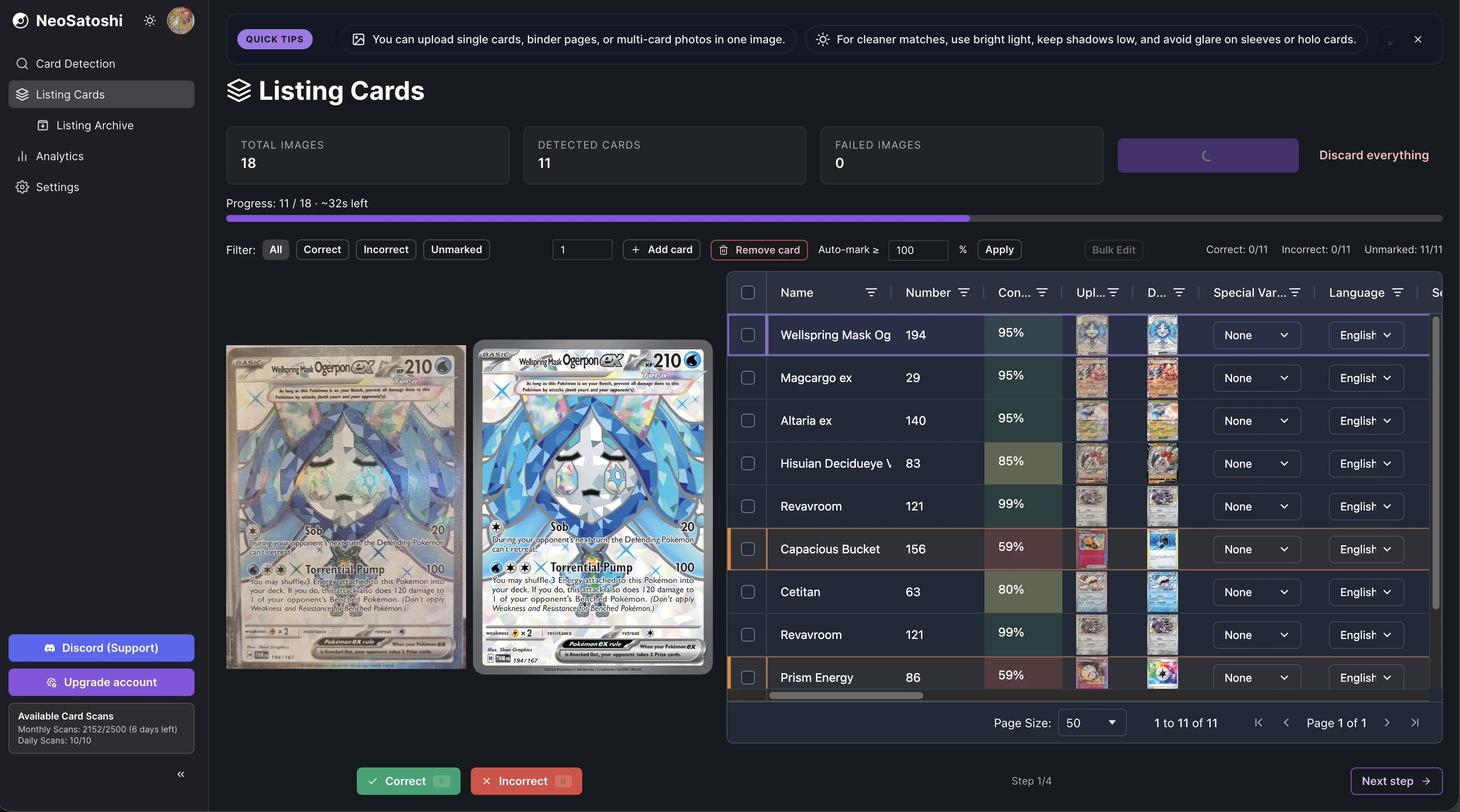
Review every match in one table
Each detected card appears with its name, set code, printed number, finish and prices. Fix a wrong match by picking another printing or by searching for the card.
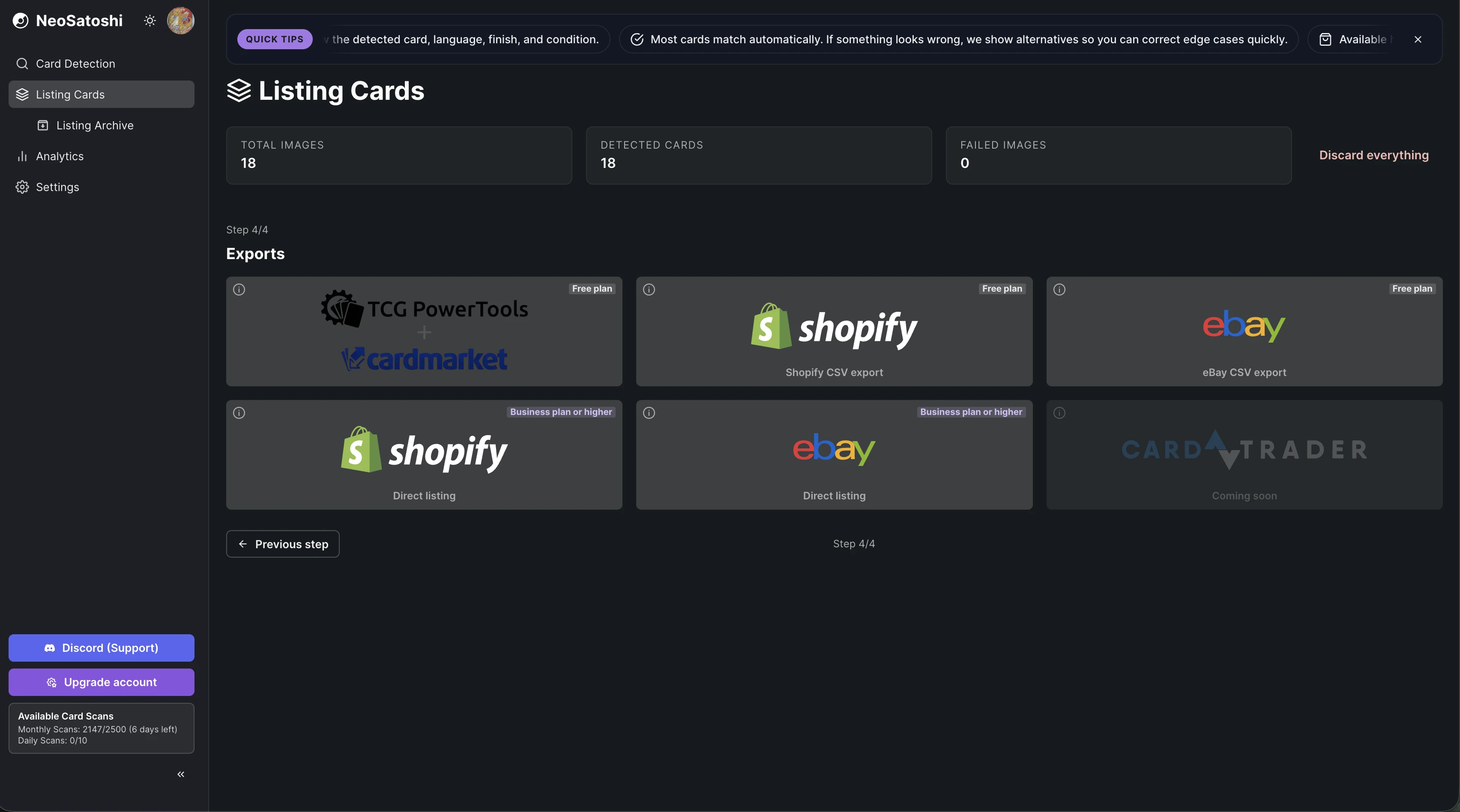
List directly or export a file
Publish to eBay or Shopify, or download the eBay, Shopify, TCGPowerTools or custom export file.
How it works
Choose Riftbound
In step 1 of Listing Cards, pick Riftbound with the card game switch. A batch is always one game.
Upload photos or scans
Upload photos or scans, or use the watched scan folder. One photo can hold several cards, such as a binder page or cards laid out on a table, best with up to about 20 cards per photo. The watched scan folder expects one card per scanned sheet.
Pick printings, finish and condition
Where the photo does not prove it, pick the printing in step 2, and switch a Common or Uncommon to foil when your copy is foil. Then set the condition. Every card starts as Near Mint (NM).
Set your prices
Start from Cardmarket or TCGplayer prices and add a markup per price range, a minimum price and rounding. Type the price of a card that has none yourself.
List or export
Publish to eBay or Shopify directly (Business plan or higher) or download the eBay, Shopify, TCGPowerTools or custom export on any plan.
Good to know before you start
You set the condition
NeoSatoshi identifies the card, it does not grade it. Every card starts as Near Mint (NM), and you change the condition per card or in bulk edit.
English listings only for now
English Riftbound cards are recognised, priced and listed. French and Chinese prints are recognised by their printing but cannot be listed or exported yet.
Several cards per photo
One photo can hold several Riftbound cards, best with up to about 20 per photo. Cards that are too small on the photo are not read, and front and back pairs still need one card per photo.
You pick what the photo cannot prove
When the photo does not show which printing it is, the row waits for your pick and has no price until then. It cannot be exported before.
Slabs from PSA, BGS and CGC
On a PSA, BGS or CGC slab the company, the grade and the cert number are read from the label, never estimated. TAG, ACE and PCG slabs are not read: you enter company and grade. A Riftbound slab has no eBay price yet, so you type its price.
Detection API only
The Detection API recognises Riftbound cards in your own photos. The card search API, which searches the catalog by name or number, does not cover Riftbound.
Common questions
- Which Riftbound cards does NeoSatoshi recognise?
- English cards of every main set from Origins on, with alternate arts, overnumbered and signed prints, runes and tokens, plus the organised play promos and the metal prize cards. French and Chinese prints are recognised by their printing but cannot be listed yet.
- How does NeoSatoshi tell alternate art, overnumbered and signed prints apart?
- By the collector line at the bottom left of the card: the set code and the number, a letter after the number for an alternate art, a number above the set total for an overnumbered print and a star for a signed one. When the photo does not show it clearly, you pick the printing, and every option shows its image, set code, number and price.
- Why does a card have no price?
- Because its printing is not known yet, and an alternate art or a signed print can cost very differently from the base print. Pick it in step 2 and the price of that printing appears. Some foil copies, alternate arts, signed and promo prints have no market price for their finish; type it yourself. NeoSatoshi never fills in a minimum price or another printing's price.
- How are foil and normal copies handled?
- Common and Uncommon cards exist in both finishes. They start as normal, and the foil switch on the row turns a copy into foil, with the foil price, "Foil" in the eBay title and its own SKU, so a foil and a normal copy are never one listing. Rare, Epic, Showcase and signed cards are foil only and always priced as foil.
- Can I list French or Chinese Riftbound cards?
- Not yet. NeoSatoshi recognises French and Chinese prints by their printing, but Riftbound is listed in English only for now. Those rows are named and kept out of listings and exports instead of being listed under the wrong language.
- Where can I sell Riftbound cards with NeoSatoshi?
- On eBay (Direct Listing or the eBay CSV), on Shopify (Direct Listing or the Shopify CSV) and on Cardmarket through the TCGPowerTools CSV. A custom CSV or JSON export is available for other tools, the stock sync keeps Shopify and eBay quantities in step, and developers can use the Detection API.
- Does NeoSatoshi grade the condition of my cards?
- No. Detection identifies the card, not its condition. Every card starts as Near Mint (NM), and you set the condition yourself before listing.
- Can I photograph several Riftbound cards at once?
- Yes. Binder pages and cards laid out on a table work, best with up to about 20 cards per photo. Each card becomes its own row, and a card that was only guessed is marked for review. With a document scanner, scan one card per sheet: any scanner that saves JPEG or PNG files into a folder works, and in desktop Chrome, Edge, Brave or Opera the watched scan folder adds new scans automatically and pairs fronts and backs.
- Do I need a paid plan?
- No. Everyone gets 10 free card scans per day, and the Free plan includes monthly card scans and every export file. eBay and Shopify Direct Listing and the daily price sync need the Business plan or higher.
- What does a Riftbound listing title look like?
- "Riftbound", the name, the set code, the printed number, a word such as Alternate Art, Overnumbered, Signature or Metal where it applies, the rarity and, on eBay, "Foil" for a foil Common or Uncommon, for example "Riftbound Kai'Sa, Daughter of the Void OGN 299* Signature Showcase". The set code and the number are never cut, because they tell the printings apart.
Don't see your question?
Browse all answers
More for Riftbound sellers
Cardmarket listing workflow
How the TCGPowerTools CSV turns a reviewed batch into Cardmarket listings.
Read more
Detection API for developers
The same card recognition for your own software. Send cards with "tcg": "riftbound".
Read more
Avoid overselling on eBay and Shopify
How the stock sync keeps one quantity for a card that sells in both places.
Read more
Daily price sync for Shopify and eBay
How your listings follow Cardmarket or TCGplayer every day, and what the sync leaves alone.
Read more
Card recognition API for other games
One request per photo for One Piece, Lorcana, Yu-Gi-Oh!, Magic, Star Wars: Unlimited, Digimon, Cyberpunk TCG and Riftbound.
Read more
Ready to list your Riftbound cards?
Start with 10 free card scans per day and see your first batch detected, priced and ready to list.